
RK3576 Motherboard PCBA Design and Custom OEM/ODM Services
Apr 27,2026
The Next-Gen RK3588 Core board
Powerful, AI-Driven, High-Performance.Shop Now>


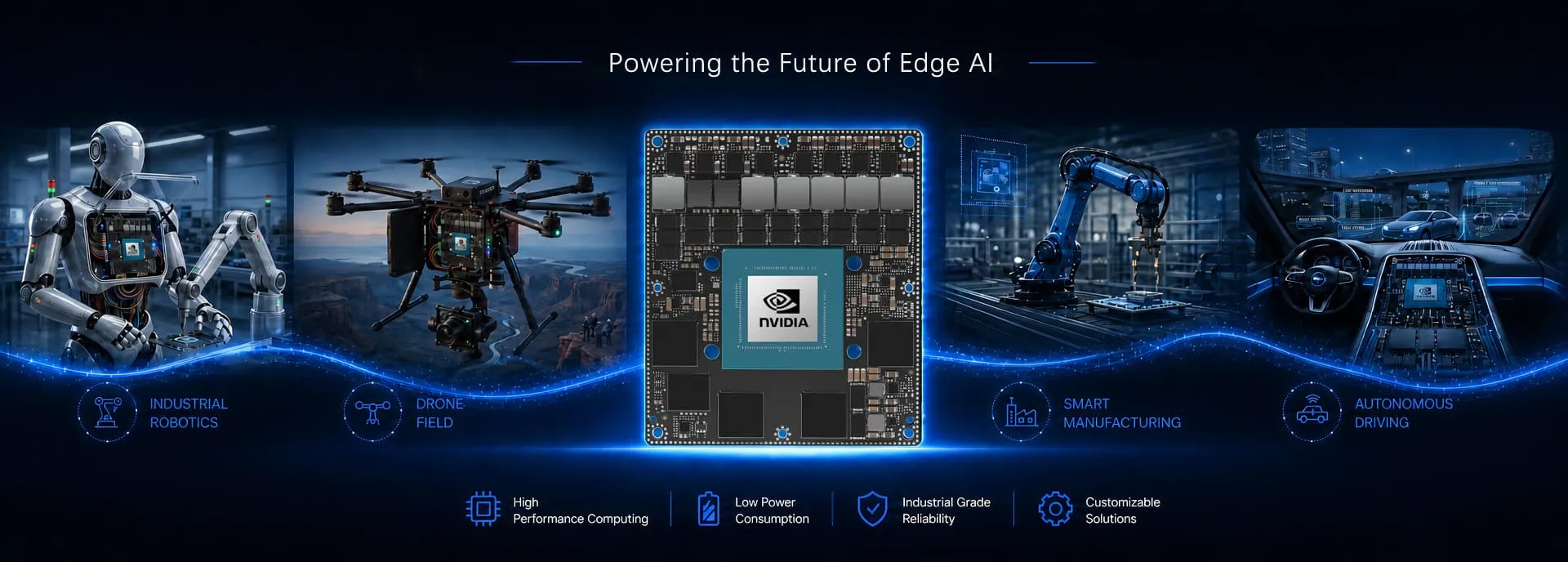


Nevertheless, deploying AI models on embedded hardware necessitates considerably more than a high-performance processor. A device must execute neural network inference operations, manage input from imaging and sensing systems, facilitate communication among interconnected equipment, and execute its core application software while operating within constrained power consumption and thermal dissipation parameters.
The Rockchip RK3588 addresses these requirements effectively. Incorporating an eight-core CPU architecture, a Mali-G610 MP4 graphics processing unit, a specialized neural processing unit (NPU) delivering up to 6 TOPS of computational capacity, and comprehensive multimedia connectivity options, the RK3588 establishes a robust hardware platform suitable for edge AI implementations. Portworld's YC-Core3588 core board integrates these functionalities into a production-ready solution designed for developers engaged in the development of sophisticated embedded intelligent systems.
The RK3588 NPU represents what?
The RK3588 is a sophisticated system-on-chip (SoC) manufactured by Rockchip, engineered for deployment in applications including intelligent displays, artificial intelligence cameras, edge computing infrastructure, and embedded multimedia platforms. This computing platform integrates four Cortex-A76 CPU cores, four Cortex-A55 CPU cores, a graphics processing unit, specialized multimedia acceleration hardware, and an embedded neural processing unit.
The NPU functions as a specialized accelerator for neural network computations employed in artificial intelligence inference tasks. Rather than requiring the central processing unit to handle every computational step within a trained neural network model, compatible processing tasks can be delegated to the NPU, enabling the system to execute supported artificial intelligence operations with substantially improved efficiency.
The RK3588 NPU achieves computational throughput reaching 6 TOPS of artificial intelligence processing capacity. TOPS denotes trillions of operations per second, with the specified metric representing maximum theoretical performance under defined operating parameters. Practical performance outcomes are contingent upon factors including model design, data precision formats, supported computational operations, available memory bandwidth, algorithmic implementation quality, and overall system architecture.
The RK3588 NPU accommodates various numerical formats, encompassing INT4, INT8, INT16, FP16, BF16, and TF32, contingent upon appropriate hardware and software capabilities. This versatility enables developers to make informed decisions when optimizing inference performance, model footprint, memory consumption, and computational precision.
For edge AI developers, the principal benefit extends beyond mere TOPS measurement. It encompasses the capacity to integrate AI acceleration alongside general-purpose computation, image processing, video decoding, and display rendering within a unified embedded system.
How Does the RK3588 NPU Function Within an Edge AI System?
A typical edge AI device executes a sequential processing workflow: data acquisition, data preparation, neural network inference, outcome evaluation, and system response. The RK3588 allocates these operations across distinct processing components in accordance with the implemented software design.
As an illustration, consider an intelligent inspection apparatus utilizing industrial imaging sensors. Video sequences can be acquired and formatted for inference execution, a suitable object-recognition model can execute on the NPU, and the CPU can analyze detection outcomes prior to initiating an alert or transmitting notification to a management infrastructure.
The CPU orchestrates application logic, manages device communication, and executes tasks that the NPU cannot efficiently process. The GPU facilitates graphics rendering and appropriate parallel computational workloads, whereas specialized video hardware manages supported video encoding and decoding operations. The NPU accelerates compatible neural network computations.
This strategic allocation of computational responsibilities enables an embedded AI system to execute multiple functions without depending exclusively on the CPU.
The software infrastructure is equally critical. Rockchip delivers RKNN-Toolkit2 for model transformation, inference assessment, and associated development activities, alongside the RKNPU2 runtime for implementing compatible models on supported platforms. Developers conventionally refine and enhance their trained models on a development workstation, transform them into RKNN format, and subsequently incorporate the runtime into the target device's application.
Model compatibility must be verified prior to implementation. Not all model operators, model architectures, or framework capabilities will necessarily execute on the NPU without adjustment. Comprehensive performance evaluation on the actual target hardware is indispensable.
Why Is a Dedicated NPU Important for Edge AI?
While CPUs are capable of executing numerous AI workloads, the continuous execution of neural network computations alongside standard application logic can deplete critical processing capacity. A dedicated NPU functions to optimize supported neural network operations, facilitating the development of responsive embedded systems.
Local inference delivers three significant practical benefits.
First, it diminishes response latency by eliminating the requirement to transmit every frame or data sample to a remote cloud server and await the corresponding result. The actual latency remains contingent upon the model architecture, preprocessing procedures, memory transfer operations, and application pipeline configuration.
Second, local processing minimizes network bandwidth consumption. An AI-enabled camera, for instance, may transmit event alerts, selected imagery, or aggregated findings rather than perpetually uploading complete video sequences for distant processing.
Third, local inference strengthens operational reliability and data governance. Devices maintain the capacity to execute supported AI functions during periods of internet disruption, provided the requisite models, data, and application services reside locally. Maintaining data on the device additionally facilitates the reduction of unwarranted exposure of confidential information.
These advantages position the RK3588 as an optimal solution for edge computing environments requiring equilibrium among computational performance, network connectivity, multimedia functionality, and implementation adaptability.
Prominent Edge AI Applications Utilizing the RK3588 NPU
Machine Vision and Intelligent Quality Inspection
Production facilities are progressively deploying AI-driven vision technologies to detect product defects, categorize components, validate assembly operations, and identify irregular conditions. An RK3588-based platform can execute compatible image-classification, object-detection, or alternative vision models on-device, contingent upon model sophistication and performance specifications.
The CPU manages production workflows and interfaces with peripheral controllers, whereas the NPU optimizes supported inference operations. Camera connectivity and multimedia processing capabilities enable developers to construct comprehensive vision systems.
For operational implementation, the model must be assessed relative to concrete specifications including image resolution, inspection velocity, false-detection percentages, and concurrent camera stream capacity. Peak NPU performance metrics alone do not ensure a specific inspection throughput rate.
AI Robotics and Autonomous Navigation
Robotic systems must comprehend their operational environment prior to determining movement or behavioral responses. AI inference facilitates the detection of individuals, recognition of objects, identification of barriers, and enhancement of visual perception capabilities.
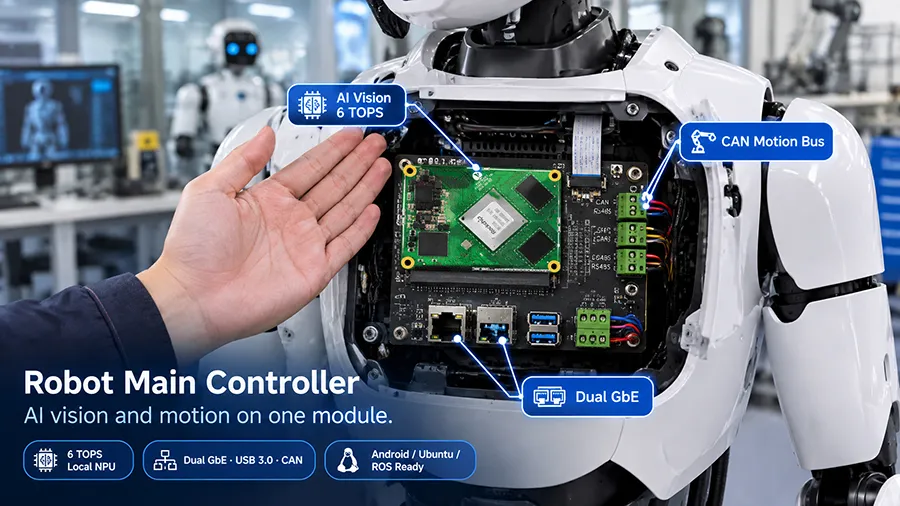
The RK3588 integrates neural network acceleration capabilities with general-purpose CPU processing, positioning it as a viable platform for service robots, inspection robots, mobile robots, and comparable embedded robotic applications.
Developers have the capability to incorporate cameras, sensors, motor controllers, and communication interfaces in accordance with carrier board specifications. For navigation systems demanding stringent real-time control, safety-critical functions, or sophisticated sensor fusion capabilities, supplementary controllers and specialized safety protocols may remain essential.
Smart Cameras and Intelligent Video Analytics
Conventional cameras primarily serve to capture and transmit video content. Artificial intelligence-equipped cameras and video gateways possess the capacity to process visual data at the edge to detect pertinent occurrences.
Leveraging its neural processing unit and specialized video processing functionalities, the RK3588 can facilitate edge-based analytics including object detection, crowd enumeration, space occupancy assessment, and designated surveillance applications when software and machine learning models are appropriately calibrated.
Its video decoding and encoding functionalities prove advantageous in architectures that integrate analytics with video presentation or archival. Nevertheless, the quantity of simultaneous video streams and attainable inference performance are contingent upon resolution specifications, frame rate parameters, codec selection, model complexity, memory throughput capacity, and the comprehensive software architecture.
Smart Retail, Digital Signage, and Interactive Displays
Commercial display systems have evolved beyond their traditional role of presenting promotional materials. Contemporary implementations now integrate audience measurement capabilities, motion-recognition technology, adaptive content management, and on-device visual processing systems.
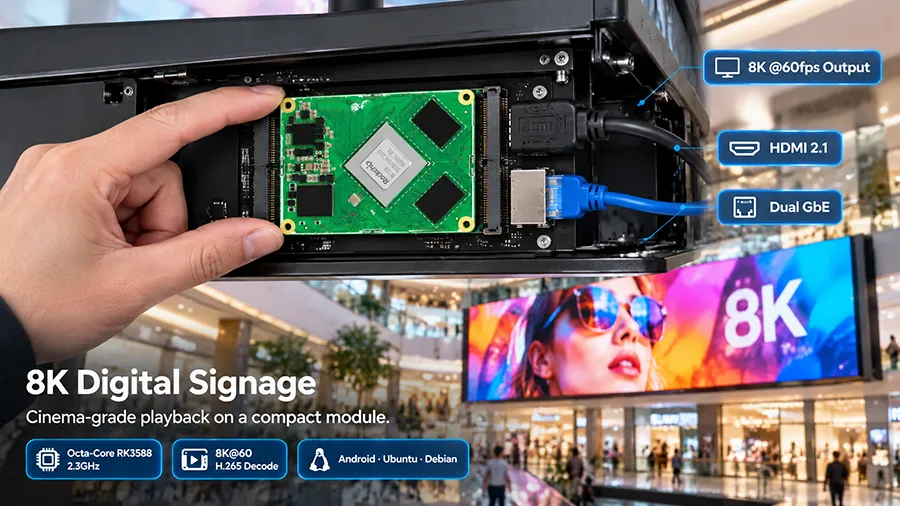
The RK3588 processor delivers integrated artificial intelligence acceleration alongside advanced graphics and multimedia capabilities, enabling developers to construct applications that seamlessly manage visual content delivery and real-time AI processing tasks. The platform's comprehensive display connectivity options facilitate adaptable hardware configurations, contingent upon the specific implementation of the host board.
For manufacturers specializing in digital signage solutions, this integrated approach substantially diminishes the requirement to develop independent computing infrastructure for graphics rendering, video encoding, and designated AI operations. The precise display output specifications and multi-display arrangement possibilities require validation against the particular interface availability provided by the carrier board.
Industrial Internet of Things and Predictive Monitoring Systems
Edge-based artificial intelligence can enable industrial systems to detect anomalous patterns within sensor data, identify visual irregularities, or categorize operational states prior to transmitting findings to a centralized infrastructure.
An RK3588-based gateway device can integrate on-site computational inference with Ethernet communication capabilities, sensor input interfaces, and enterprise-level application protocols. This configuration proves advantageous when industrial machinery requires autonomous decision-making capacity while maintaining connectivity with manufacturing facility networks or cloud-based management platforms.
Successful predictive maintenance implementation necessitates adequate historical training datasets, rigorously validated algorithmic models, and properly configured sensor infrastructure. The neural processing unit delivers computational performance enhancement; however, it does not autonomously ensure dependable fault forecasting accuracy.
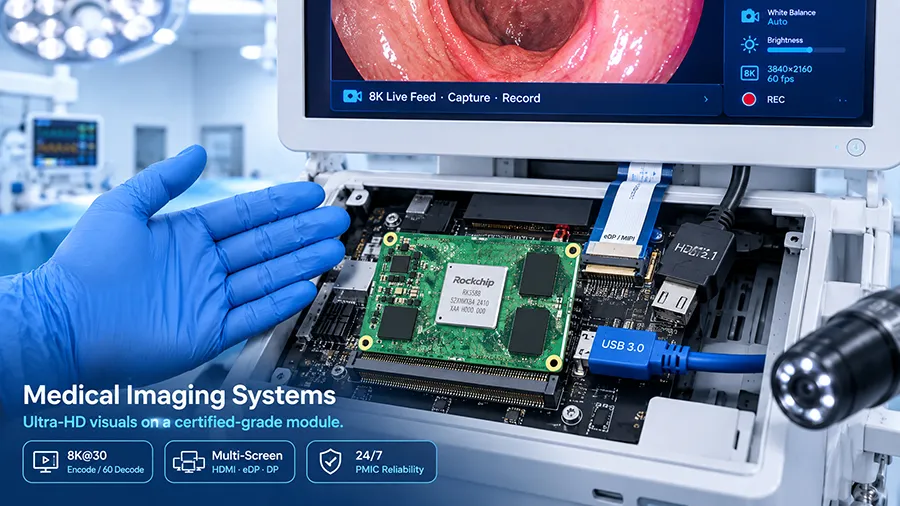
Advantages of Implementing an RK3588 Core Board Versus Custom Development
Selecting an appropriate system-on-chip represents merely an initial phase in manufacturing an embedded artificial intelligence solution. A production-grade system additionally demands a dependable electrical power distribution framework, memory and data storage components, optimized high-frequency signal transmission pathways, connectivity modules, heat dissipation solutions, compatible software environments, and a structurally sound mechanical framework.
Developing all of these elements from the ground up can increase engineering workload and extend product development cycles.
An RK3588 core board provides a more integrated starting point. It allows development teams to focus on the carrier board, application-specific interfaces, software, enclosure, and product functionality rather than implementing every part of the computing platform independently.
Portworld's YC-Core3588 is an RK3588-based core board designed for integration into embedded and edge computing products. Its main capabilities include:
High-performance processing: Four Cortex-A76 cores and four Cortex-A55 cores for application processing and multitasking.
Dedicated edge AI acceleration: An integrated NPU rated at up to 6 TOPS for compatible neural network workloads.
Advanced multimedia: Support for demanding video processing and high-resolution display applications, subject to system implementation.
High-density interconnection: A 400-pin board-to-board design using four 100-pin connectors for system integration.
Peripheral expansion: Interfaces including PCIe, SATA, USB, and Ethernet, according to the core board and carrier board design.
Operating system flexibility: Android, Ubuntu, and Debian options for different embedded development requirements.
This combination makes the YC-Core3588 relevant to developers building AI inspection systems, smart cameras, robotics platforms, intelligent terminals, and commercial display equipment.
Software Optimization: Converting 6 TOPS into Actionable AI Performance
An advanced NPU does not inherently enable all AI models to operate with optimal efficiency. Model selection, conversion, quantization, memory management, and application integration collectively determine the ultimate outcome.
A standard RK3588 AI implementation workflow commences with identifying a model appropriate for the intended application. Developers subsequently assess whether its operators and layers are compatible with the corresponding Rockchip software ecosystem. The model can be transformed into RKNN format utilizing RKNN-Toolkit2, followed by validation of accuracy and performance metrics.
Quantization can diminish model size and enhance inference performance in applicable scenarios, though developers must verify the impact on accuracy. INT8 quantization is frequently selected for edge inference because it delivers a favorable equilibrium between performance and model fidelity. Additional supported precision formats may prove suitable for specific use cases.
The subsequent phase involves refining the comprehensive processing workflow. For vision-based applications, this may encompass orchestrating video acquisition or decoding, image preprocessing, NPU inference, CPU-based postprocessing, and result delivery. Redundant memory transfers can introduce latency, whereas continuous workloads can elevate thermal requirements.
Developers should consequently evaluate the entire application on the target hardware, incorporating the actual model, input resolution, frame rate, number of streams, and operational context.
A thorough assessment should quantify inference latency, throughput, CPU and NPU utilization, memory usage, power consumption, thermal characteristics, and model accuracy. These metrics establish a more substantive foundation for hardware selection than maximum TOPS specifications alone.
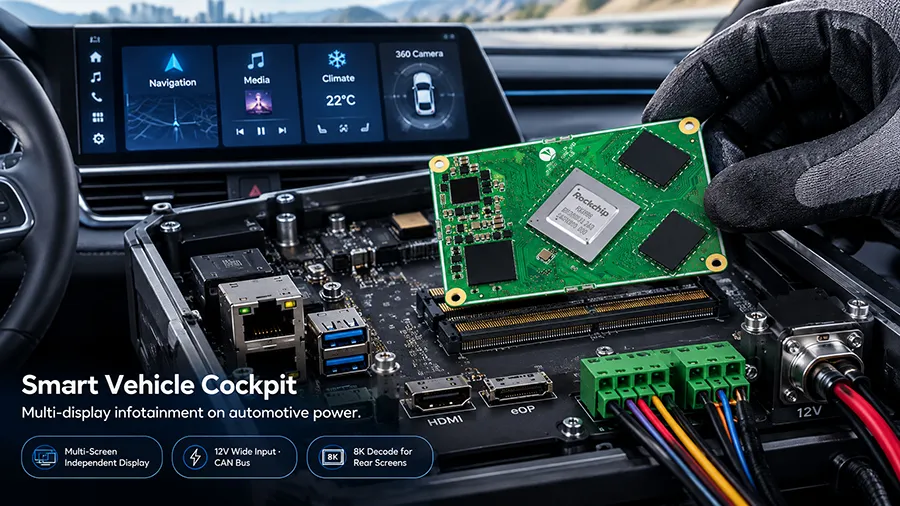
Customized RK3588 Artificial Intelligence Hardware Development via Portworld
Edge artificial intelligence applications necessitate distinct hardware specifications based on their intended function. A machine vision terminal may emphasize camera connectivity and rapid data storage capabilities, whereas a robotics control system may demand supplementary communication protocols, resilient power management, and a space-efficient housing design. A commercial display system may require particular video output specifications and specialized mechanical configuration.
Portworld facilitates specialized embedded hardware development utilizing the YC-Core3588 architecture, enabling clients to customize their computing infrastructure according to specific product specifications. Depending on the extent of the project, customization options may encompass carrier board engineering, interface specification, circuit board and assembly manufacturing, electrical power design, housing implementation, operating system customization, and production facilitation.
Software implementation and artificial intelligence model integration must be established in accordance with project specifications and verified against the designated hardware and software configurations. When necessary, technical services may include driver customization, system optimization, software integration, and validation procedures.
For organizations creating proprietary artificial intelligence-enhanced products, this methodology delivers an efficient pathway from hardware assessment and prototype fabrication through to tailored mass production.
The RK3588 NPU supports edge AI by accelerating compatible neural network inference directly on the device. Combined with an octa-core CPU, GPU, multimedia processing hardware, and extensive connectivity options, it provides a flexible foundation for machine vision, robotics, smart cameras, industrial IoT, and intelligent displays.
However, successful edge AI deployment depends on more than the NPU's peak performance. Model compatibility, software optimization, memory bandwidth, thermal design, and application-level testing all determine how effectively the hardware performs in a real product.
For developers who need an integration-ready RK3588 platform, Portworld's YC-Core3588 core board offers a foundation for customized edge AI hardware. With appropriate system design and model optimization, it can help product teams build embedded AI solutions tailored to their performance, connectivity, and deployment requirements.